
Product
VIA. Turn an idea into a real product.
You bring an idea or a problem. VIA works through it with you, from the first question to software that runs. You leave with a product that is yours.
VIA is software. Specialist agents do the work. You make the decisions, and VIA asks you when a judgment needs a person.
What VIA can do for you
VIA works in four stages. Each stage ends with something you can use.
1
A decision on the opportunity
You learn who has the problem, how they solve it today and if it is worth a product. Then you decide to go on or to stop.
2
A commitment you can show
You get a strategy and a product definition. You can put them in front of an investor, a board or a partner.
3
Software that runs
VIA builds the product from its definition. You get working code, its tests and a record of each decision.
4
A product on market
VIA releases the product to the people it serves and guides the operations. You learn from user feedback and improve.
What VIA is
VIA is an operating system for product development.
VIA runs products the engineered way, over their full lifecycle, with the audit trails and the discipline that regulated industries require.
What comes out is yours: the code, the documents and the record of every decision.
It runs the whole life of a product
From the first question to the market, and through every release after.
It schedules the work
Specialist agents in product, design, engineering and quality carry the work. VIA puts each task in its turn and brings you the result.
It keeps the record
Every claim shows its source. Every decision has a record. Every release carries its tests.
It enforces the rules
Who may decide what, and what a release must carry. VIA follows the rules of the organization that runs it.
It accounts for value
VIA measures what the tokens and the hours spent on a product return.
It runs where you need it
Shared, dedicated or sovereign, in your own custody. The same VIA in every case.
What VIA covers
What VIA does at each stage, and what stays with you
We start with the opportunity. With that sorted, we strategize, define the product, and release it. Once the product is live, we learn and improve.
Opportunity
VIA 1.0
VIA does
- Problem and market
- Users and reference products
- Every claim sourced
You do
- Bring the idea
- Go on or stop
Definition
VIA 1.1
VIA does
- Strategy and positioning
- Business model and scope
- Domain model and experience
- Architecture
- Expert reviews
You do
- Decide where VIA asks
- Show the commitment
Build
VIA 1.2
VIA does
- Code with tests, in your repository
- A record of each decision
- Work items and the loop
- Reads a product you already have
You do
- Test and iterate
- Review and accept
Release
VIA 1.3
VIA does
- Releases
- Deployment
- Go-to-market package: brand, launch, pages, sales kit
You do
- Decide the release
- Own the hosting account
Running the product
And onwards
VIA does
- The operations plan
- Reliability targets
- Observability and incident response
- Data protection
You do
- Host, operate, monitor
- Incidents and support
- Sell and market
Each chapter in detail, with what VIA plans, produces and runs for you: the VIA roadmap.
VIA at work
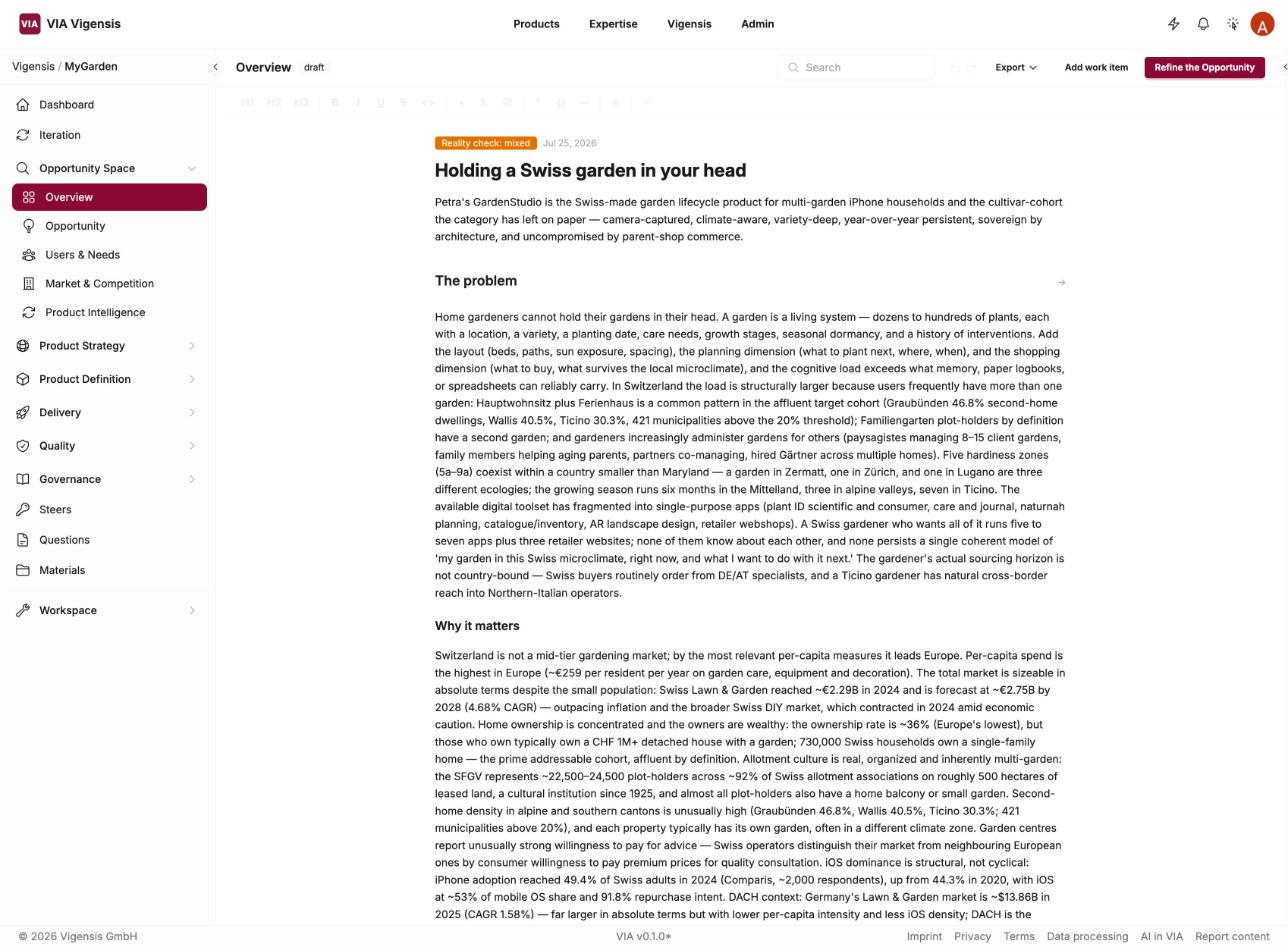
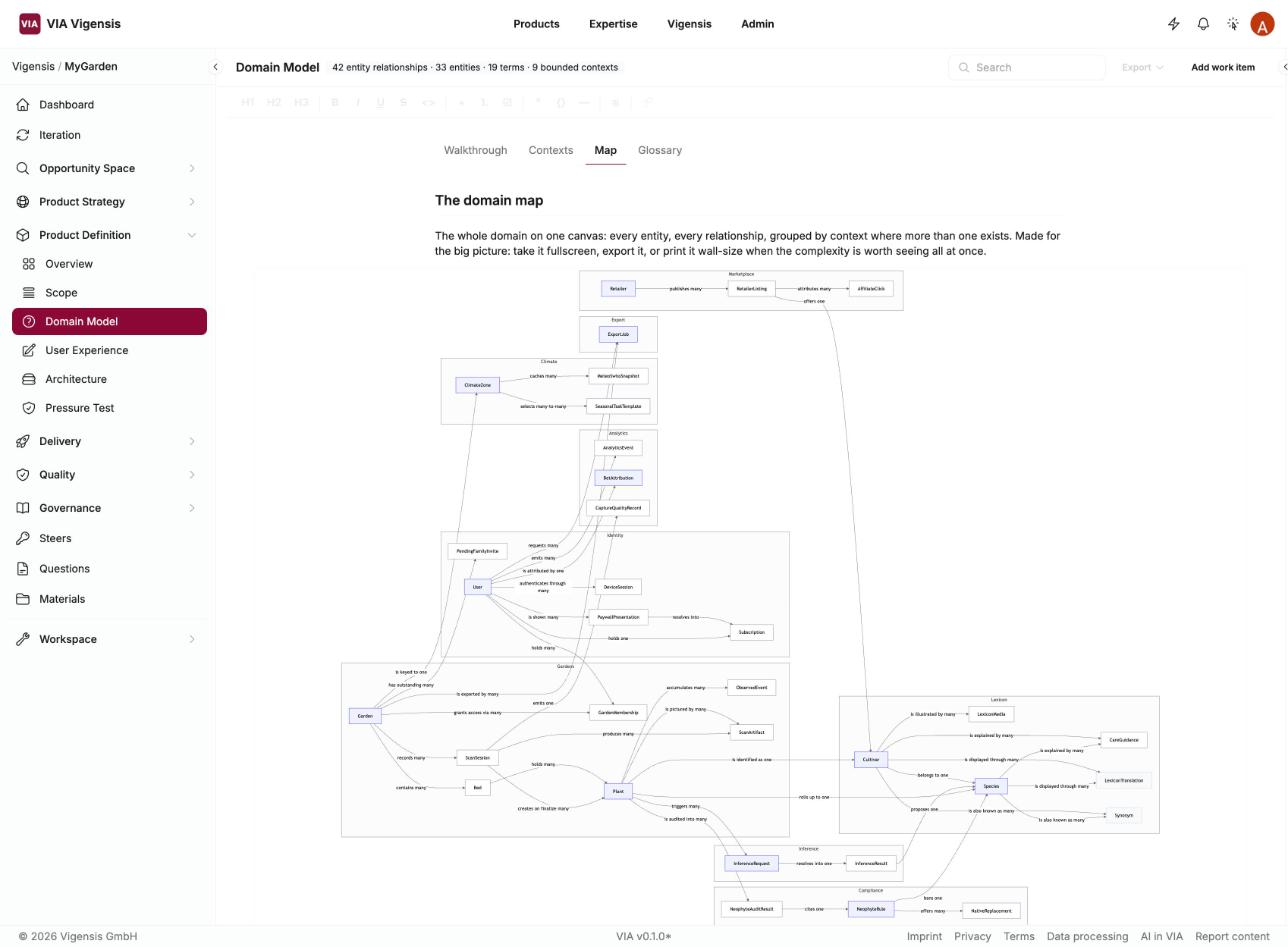
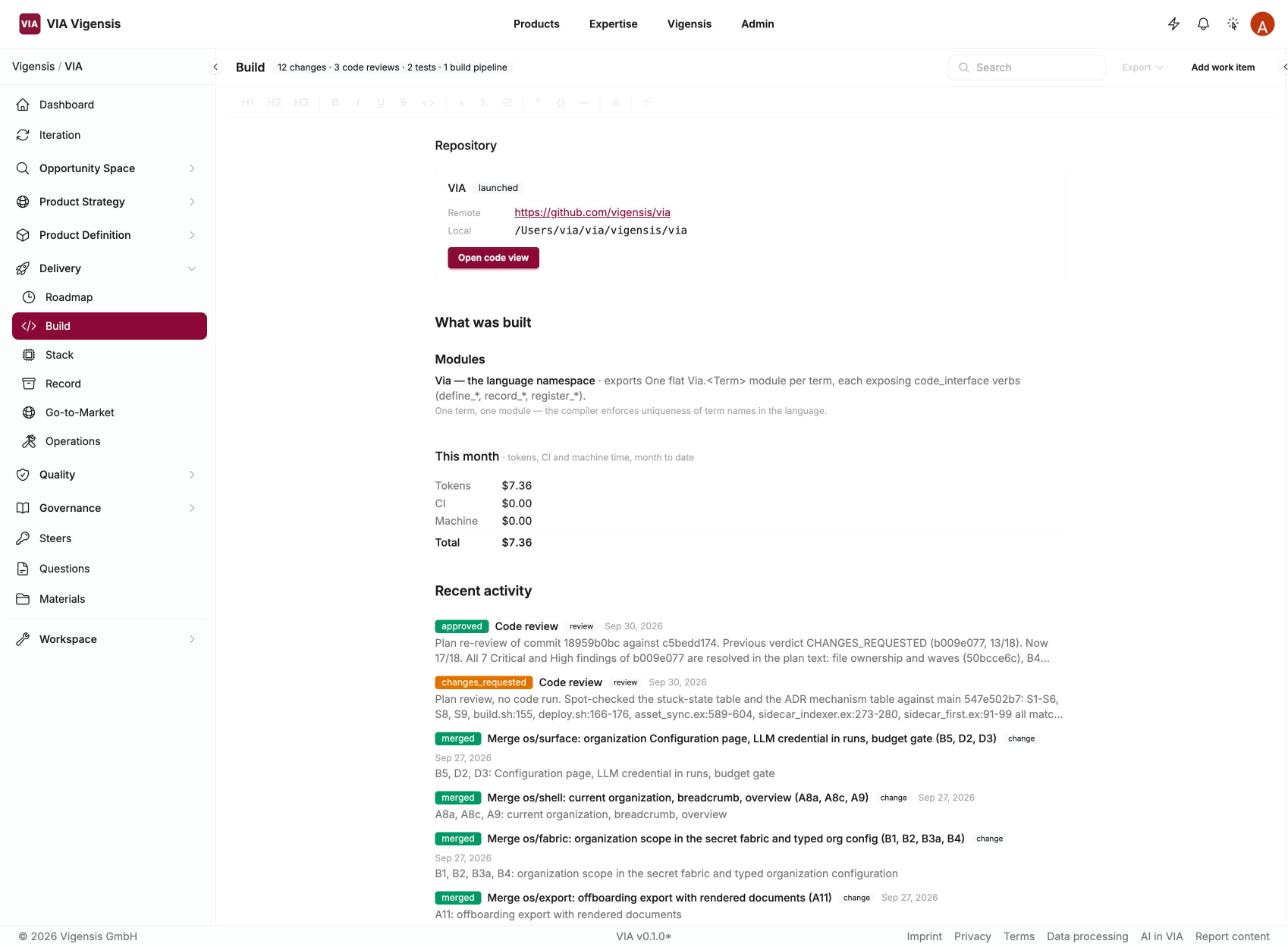
Four screens from VIA, one per stage. The product shown is MyGarden, a garden app in its definition stage, and VIA itself, which VIA builds.
Stage 1
The opportunity, written out
The problem, who has it and why it matters now. Every claim carries its source.
Stage 2
The product, defined
The domain map puts every entity and every relationship on one canvas.
Stage 3
The build, on record
Merged changes, code reviews and what the month cost, on one page.
Stage 4
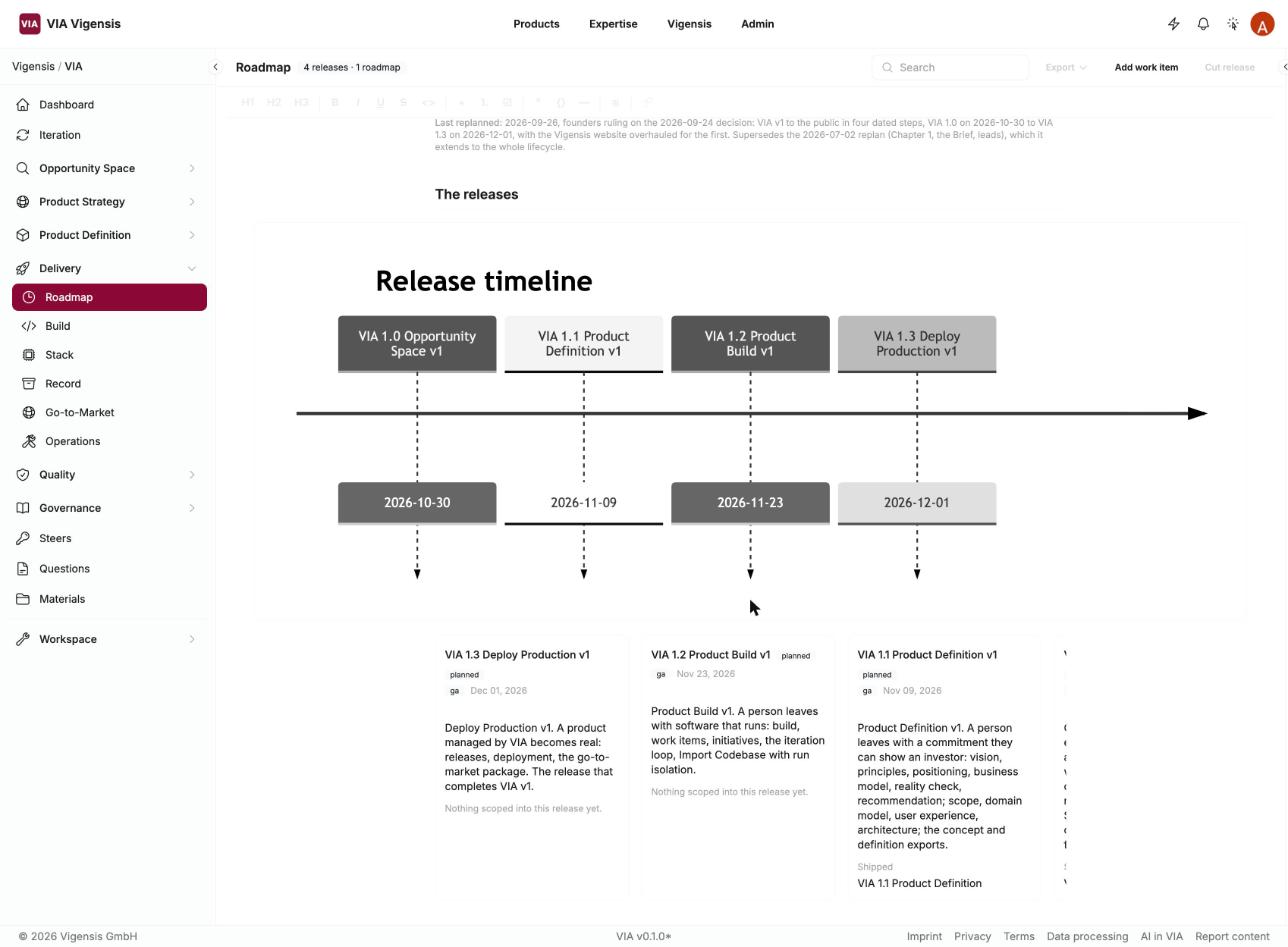
The releases, dated
The roadmap names each release, its date and what it holds.
VIA builds VIA
We build VIA with VIA. Its research, its decisions and its code come from the same stages that you use. This website is a product in VIA too.
We use VIA every day. It is how a small team delivers what used to take a large one.
Let's Talk
30 minutes. No pitch. A conversation about what you build and whether we can help.
Prefer email? [email protected]